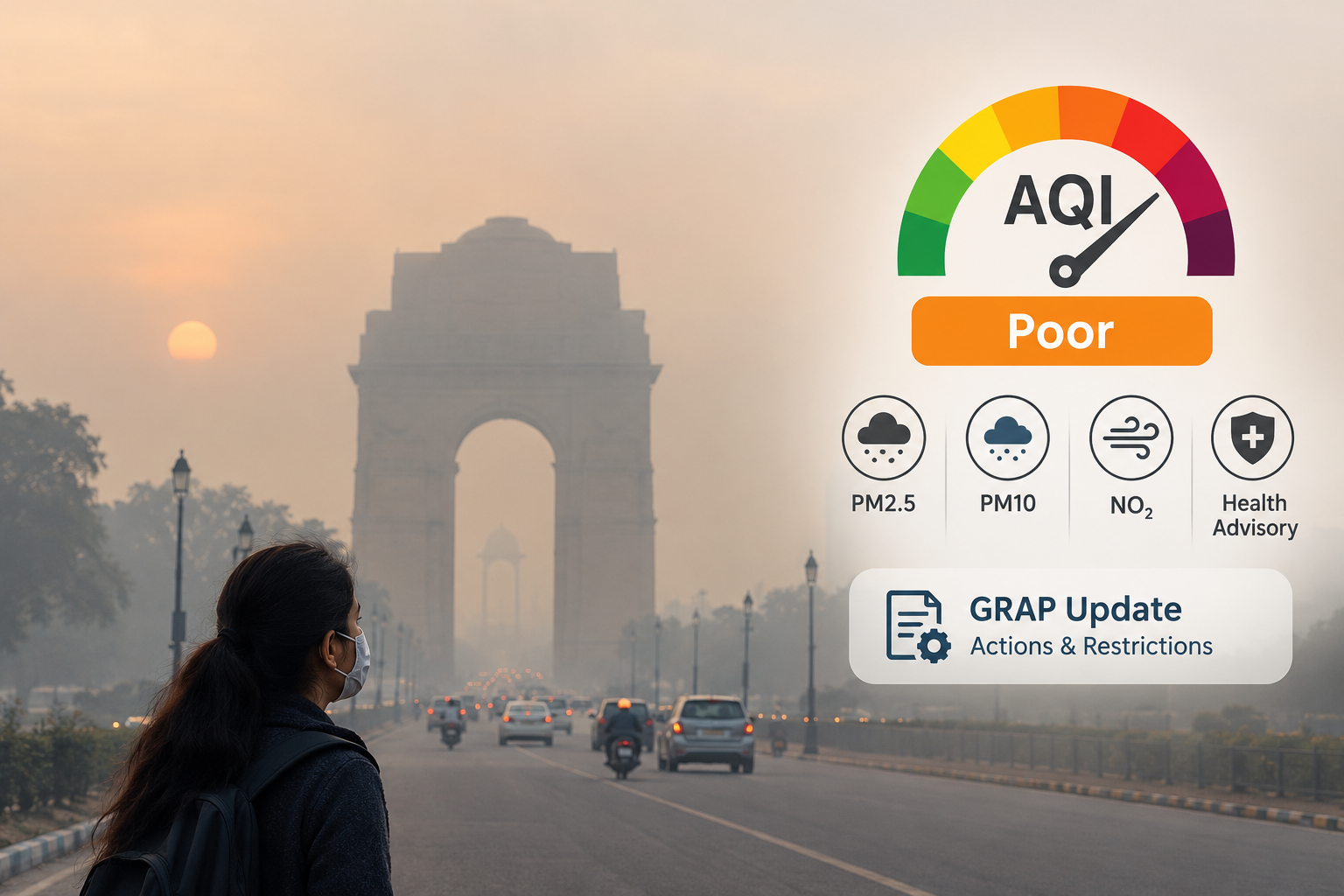
Delhi’s air quality has worsened as the city moves deeper into the autumn pollution season. On 21 October, Delhi’s city-level Air Quality Index (AQI) rose from 179 on the previous day to 244 in the afternoon, moving from the Moderate category into the Poor category. Authorities responded by bringing Stage I of the Graded Response Action Plan (GRAP) into force across the National Capital Region. For Thursday, 22 October 2026, the air-quality outlook indicates that Delhi is likely to remain in the Poor category.
That distinction matters: the latest confirmed reading and the forecast for the next day are not the same thing. A live monitoring station can change through the day, while the final daily average is calculated later. This update explains what is known, what the forecast suggests, what GRAP Stage I means for residents, and how to make practical decisions about commuting, exercise and time outdoors.
The key message is simple: do not treat one AQI number as a complete picture of personal exposure. Check the latest reading for your area, consider how long you will be outside, and take extra care if you are a child, an older adult, pregnant, or living with a heart or lung condition.
Delhi AQI today, 22 October 2026: Latest status
The latest confirmed city-level update available before 22 October placed Delhi’s AQI at 244 at 2 pm on 21 October, with the reading reported at 245 by 4 pm. Both values fall within the Poor band of India’s AQI scale. On 20 October, the city had recorded an AQI of 179, which falls in the Moderate category. The quick change shows why checking current information is more useful than relying on yesterday’s number.
For 22 October, the air-quality forecast points to Poor conditions. This is a forecast rather than a verified full-day average for Thursday. Local conditions can differ between monitoring stations and neighbourhoods, and readings may move during morning, afternoon and evening as wind, traffic and other emissions change.
Readers should use a live AQI dashboard or official bulletin for the most recent station-level value before travelling or planning outdoor activity. If a headline gives one number without a time, location or category, treat it cautiously. An AQI value is most useful when accompanied by the reporting time and monitoring location.
What does an AQI of 201–300 mean?
India’s AQI scale groups air quality into categories to make pollution information easier to interpret: 0–50 is Good; 51–100 is Satisfactory; 101–200 is Moderate; 201–300 is Poor; 301–400 is Very Poor; and 401–500 is Severe. Delhi’s latest reported reading of 244 therefore falls in the Poor category.
Poor air quality does not mean every person will experience the same symptoms or level of risk. It does mean pollution can be a concern, particularly for sensitive groups. People with asthma or other lung disease, people with heart conditions, older adults and children may be more vulnerable to particulate pollution. Some people may notice throat irritation, coughing, wheezing, eye irritation or shortness of breath, while others may not immediately feel symptoms.
The absence of symptoms is not proof that exposure has no effect. Risk depends on the pollutant mix, concentration, duration of exposure, activity level and a person’s health. Heavy outdoor exercise increases the amount of air inhaled, so choosing a lower-pollution time or an indoor alternative can be sensible when readings are poor.
AQI is a communication tool, not a personal medical diagnosis. Anyone experiencing severe breathing difficulty, chest pain or a rapidly worsening medical problem should seek urgent medical care rather than relying on an AQI app for guidance.
GRAP update: Stage I is in force across Delhi-NCR
Stage I of the Graded Response Action Plan was invoked with immediate effect on 21 October after Delhi’s air quality entered the Poor category. GRAP is a phased set of pollution-control actions for Delhi-NCR. The aim is to step up enforcement and reduce avoidable emissions as air quality deteriorates, with stronger measures available if conditions worsen.
Stage I is linked to the Poor AQI band of 201–300. Measures include intensified mechanised road sweeping and water sprinkling to reduce road dust, regular collection of municipal solid waste and construction-and-demolition waste, strict action against open waste burning, and dust-control requirements at construction sites. Agencies are expected to inspect and enforce applicable rules rather than relying only on public advisories.
The Stage I framework also calls for action on other avoidable sources, including restrictions on coal and firewood in certain food-service settings and closer oversight of diesel generator use, subject to applicable rules and exemptions. The exact obligations depend on the current GRAP schedule and directions issued by authorities, so businesses should consult the latest official order rather than relying on a social-media summary.
The current move to Stage I does not, by itself, mean all schools must close, every vehicle is banned, or the city has entered the most severe emergency stage. Any separate decision about schools, offices, traffic or construction should be checked against a specific government order. If the AQI worsens, authorities may review whether higher-stage measures are required.
What residents should know about restrictions
For most residents, Stage I is primarily a signal that enforcement and dust-control measures should intensify. It is not a blanket stay-at-home order. People can continue normal activities while making sensible choices about exposure and following any local directions that apply to their area or workplace.
Construction operators should ensure that sites comply with dust-suppression rules, materials are properly covered, debris is handled responsibly, and dust is not allowed to spread onto nearby roads. Businesses using generators or solid-fuel cooking equipment should check the rules that apply to their equipment and category. Residents should avoid burning leaves, rubbish or other waste and report persistent open burning through the relevant municipal or pollution-control channel.
Commuters can help reduce emissions by using public transport, sharing rides, or combining errands to avoid repeated short car trips. Reducing the number of vehicles on the road can help limit traffic-related emissions. However, the most effective response combines personal choices with enforcement of industrial, construction, waste and transport rules.
Do not assume that a restriction has started simply because it has appeared in an old post. Rules can be updated, and exemptions may apply to emergency services or essential activities. Check the date and wording of any notice before changing work, travel or school plans.
Why pollution can rise in late October
Delhi’s pollution is shaped by a combination of emissions and weather. Road traffic, construction dust, industrial activity, waste burning, combustion sources and regional pollution can all contribute. During autumn and winter, calmer winds and atmospheric conditions can limit how quickly pollutants disperse. Pollution can build up near the surface, particularly during periods when the air is relatively stagnant.
Crop-residue burning in neighbouring states is often discussed during this season, but it should not automatically be treated as the only cause of a particular day’s AQI. The contribution from different sources changes by day and weather pattern. Local traffic, dust, industrial emissions and regional transport can all matter. A meaningful response requires action on multiple sources at once.
Weather forecasts can help explain whether pollution is likely to disperse or remain trapped, but they do not provide a guaranteed AQI number. Wind speed and direction, temperature, mixing conditions, humidity and changes in emissions can alter the result. A forecast that says Poor conditions are likely should be read as a warning to prepare, not as a promise that every monitoring station will show the same reading throughout the day.
The practical takeaway is to track both the AQI and the forecast. If the category is Poor and the weather suggests limited dispersion, it is sensible to reduce unnecessary outdoor exertion and watch for official updates.
How to reduce exposure on 22 October
- Check the latest AQI before leaving home. Look at the time and station location, not just the headline number. If possible, compare a nearby monitoring station with the city-wide reading.
- Adjust strenuous outdoor exercise. When pollution is Poor, consider moving intense running, cycling or outdoor training indoors, particularly if you are in a sensitive group. A quieter road is not necessarily a clean-air route, but avoiding busy traffic corridors can reduce some direct exposure.
- Choose transport thoughtfully. Public transport, shared rides and trip planning can reduce the number of individual vehicle journeys. If walking or cycling is necessary, consider the route, duration and intensity, and follow local safety conditions.
- Keep indoor air cleaner where practical. Keep windows closed during periods when outdoor pollution is high, if indoor temperature and ventilation needs allow. Reduce indoor smoke from cigarettes, incense, candles and solid-fuel cooking. A properly sized air purifier with an effective particle filter may help in an enclosed room, but it does not remove every pollutant and requires maintenance.
- Use a well-fitting mask when appropriate. A certified, well-fitting particulate respirator such as an N95/FFP2-type mask can reduce inhalation of particles when worn correctly. Gaps around the nose and cheeks reduce effectiveness. A mask is not a substitute for reducing prolonged exposure, and it does not protect equally against all gases.
- Protect children and older adults. Consider shorter outdoor play sessions or indoor alternatives when air quality is poor. Schools and families should follow current local advisories and avoid assuming that a closure or special timetable exists unless announced.
- Follow your care plan if you have a respiratory or heart condition. Keep prescribed medicines available and follow advice from your clinician. If symptoms become more frequent or severe, seek medical guidance. Do not start or stop medication based only on an AQI reading.
- Avoid adding to local pollution. Do not burn leaves or rubbish, keep vehicles maintained, avoid unnecessary idling, and follow waste-disposal rules. Individual actions cannot replace government enforcement, but they can help reduce avoidable emissions.
Is it safe to go outside when AQI is Poor?
There is no single yes-or-no answer for every person and activity. A short essential trip may be reasonable for many people, while prolonged, strenuous outdoor exercise creates more exposure. People who are especially sensitive to air pollution should be more cautious and use personal medical advice as their guide.
If you need to be outside, reduce the duration of strenuous activity, take breaks indoors and pay attention to symptoms. Consider postponing non-essential outdoor workouts until conditions improve. If you develop unusual wheezing, persistent coughing, dizziness, chest discomfort or breathlessness, stop the activity and move to a cleaner indoor environment. Severe symptoms require urgent medical attention.
People should not panic or self-diagnose from a single reading. Instead, use AQI information to make proportionate decisions. A clear routine—check the reading, plan the trip, reduce intense exposure and follow official advisories—is more useful than repeatedly refreshing multiple apps without changing behaviour.
What to expect next: forecast and monitoring
The outlook available ahead of 22 October indicates that Delhi’s air quality is likely to remain in the Poor category through 22–24 October, with the broader outlook also pointing to continued Poor conditions. This suggests residents should be prepared for another day of elevated pollution rather than assuming the move into Poor air quality will quickly reverse.
Still, a forecast is not a guarantee. A change in wind, emissions or atmospheric mixing can shift readings. Conversely, conditions can worsen even when a forecast initially looks stable. Authorities review AQI alongside weather and air-quality projections when deciding whether to maintain or intensify GRAP actions.
For a reliable daily check, look for three things: the latest city-level average, the time-stamped reading from a nearby station, and the most recent GRAP order. Keep the date visible when sharing a screenshot or post, because an old reading can circulate long after conditions have changed. If official status changes, update this article rather than leaving a dated headline to imply that yesterday’s number is still current.
Conclusion
Delhi enters 22 October with air quality in the Poor category and Stage I of GRAP in force across NCR. The latest confirmed city reading reached 244 on 21 October, while the forecast suggests Poor conditions are likely to persist on Thursday. The precise AQI for 22 October should be confirmed through live readings and the final daily bulletin.
For residents, the best response is practical rather than alarmist: check current conditions, reduce strenuous outdoor activity when appropriate, protect sensitive family members, avoid adding to pollution, and follow official directions. For authorities and businesses, Stage I is a reminder that dust control, waste management, cleaner operations and consistent enforcement matter before pollution reaches more serious levels. For continuing Delhi and public-interest updates, Fact Media24 aims to make the facts easier to understand and the next steps clearer. Recheck the latest AQI and GRAP status before making time-sensitive decisions, because both air quality and official measures can change during the day.
Frequently Asked Questions (FAQs)
What is Delhi’s AQI today, 22 October 2026?
The outlook available ahead of 22 October indicates Delhi is likely to remain in the Poor category. The latest confirmed city-level reading before the date was 244 at 2 pm on 21 October. Check a live official dashboard for the latest time-stamped value on 22 October.
What category is an AQI of 244?
An AQI of 244 falls in India’s Poor category, which covers readings from 201 to 300.
Is GRAP Stage I active in Delhi on 22 October 2026?
Stage I was invoked across Delhi-NCR with immediate effect on 21 October after Delhi entered the Poor category. Confirm the latest official order for any subsequent change.
What restrictions apply under GRAP Stage I?
Measures include intensified road sweeping and water sprinkling, dust-control enforcement at construction sites, regular waste removal, action against open burning and other source-specific controls. Check the current order for exact requirements and exemptions.
Are schools closed because of GRAP Stage I?
Stage I does not automatically mean schools are closed. Follow a specific government or school-authority announcement for any closure, hybrid timetable or other change.
Is Delhi AQI expected to improve on 22 October?
The forecast available before 22 October indicates Poor air quality is likely to continue. Forecasts can change, so check the latest official bulletin.
Can I exercise outdoors when Delhi AQI is Poor?
Consider moving strenuous exercise indoors or reducing its duration, especially if you are in a sensitive group. Check current conditions and follow medical advice if you have a heart or lung condition.
Which mask can help reduce particle exposure?
A well-fitting certified particulate respirator such as an N95/FFP2-type mask can reduce exposure to airborne particles when worn correctly. It does not protect equally against all gases and is not a substitute for limiting exposure.
Why does Delhi pollution rise in October?
Seasonal weather can reduce pollutant dispersion, while traffic, dust, industry, combustion, waste burning and regional sources contribute in varying proportions. No single source explains every day’s AQI.
Where can I check Delhi’s live AQI?
Use official air-quality dashboards or bulletins and note the reporting time and station location. Compare a nearby station with the city-level average where possible.
Does Poor AQI affect everyone in the same way?
No. Exposure duration, activity level, pollutant mix and individual health all matter. Children, older adults and people with heart or lung conditions may be more vulnerable.
What should I do if pollution causes breathing symptoms?
Stop strenuous activity and move to a cleaner indoor environment. Follow your clinician’s care plan. Seek urgent medical care for severe breathlessness, chest pain or rapidly worsening symptoms.
What do you feel about this post?

Like

Love

Happy

Haha

Sad